Wintercircus
Project Profile
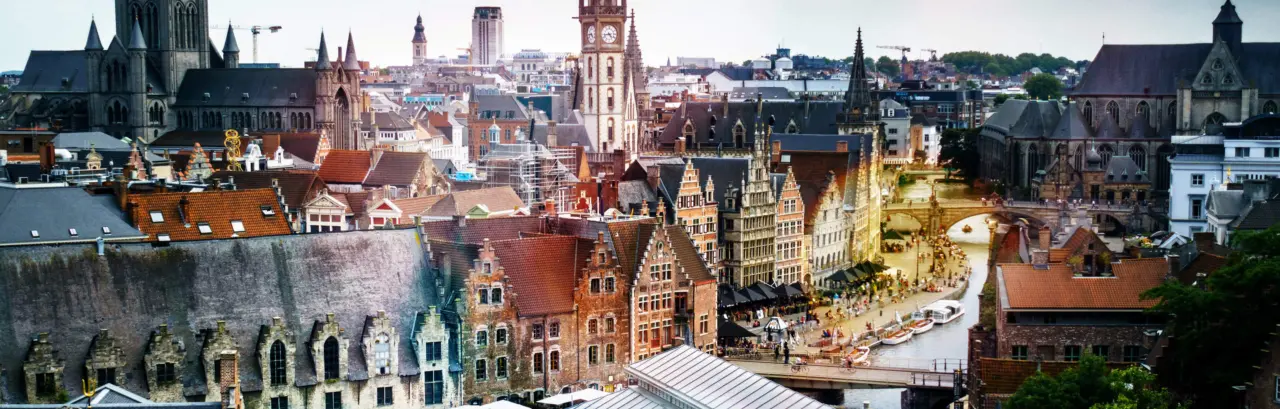
The Wintercircus situated in the heart of Ghent, Belgium, was originally constructed in 1894 as a covered circus arena designed for winter performances. Its function evolved over the years to include a car showroom and garage for the Mahy family, a well-known name in Belgian automotive history, and as a pop concert venue. The building was abandoned for years until the City of Ghent acquired it. The renovation was launched to transform the site into a vibrant creative hub that includes offices, cultural event spaces, a public plaza, restaurants, and an underground event hall, making it a multifunctional urban destination.
Jensen Hughes was engaged by the project's architect to provide expert fire safety consulting for this project. The team conducted a conformity assessment to evaluate whether the existing building and renovation plans aligned with current Belgian fire codes.
Given the building’s unique characteristics, particularly the central atrium, a performance-based design approach was required. Our team developed several derogation proposals, supported by ASET (Available Safe Egress Time) and RSET (Required Safe Egress Time) analysis, to ensure a high level of fire safety despite deviations from prescriptive codes.
Our team of experts reviewed the earlier work and provided updated evaluations, which were then used to refine the design. Advanced simulations, including Computational Fluid Dynamics (CFD) and Fire Dynamics Simulator (FDS) models, were completed to analyse smoke movement and fire behaviour. These results were shared with and validated by the local fire brigade.
A fire strategy report was developed, encompassing the means of escape and evacuation planning, compartmentation design, and requirements for sprinkler, smoke and heat control and fire detection systems. Evacuation modelling was performed using simulations to predict occupant movement and ensure safe egress under various conditions. The central atrium presented a major challenge in terms of smoke control and vertical fire spread. As an existing architectural feature, its preservation demanded innovative solutions that met safety requirements. Integrating modern systems into the historic structure was another complexity. Therefore, sprinkler systems, smoke extraction, and alarm control infrastructure had to be carefully designed to work within the constraints of the existing architecture.
We continue to play a key role in the project, supporting technical validations, coordinating with stakeholders, and ensuring compliance as the fit-out phase progresses into the final stages.

RELATED PROJECTS + INSIGHTS
Partner with us and imagine what we can achieve together!
Meet Our Project Experts
Simon Loosvelt
Project Manager
Simon Loosvelt
Project Manager
MS, Fire Safety Engineering, BS, Civil Engineering
Nazim Yakhou
Lead Engineer
Nazim Yakhou
Lead Engineer
Fire Safety Engineering, Industrial risk Management
Chiraz Alili
Fire Safety Engineer
Chiraz Alili
Fire Safety Engineer
International Master of Fire Safety Engineering, Industrial Risk Management
Related Services
Learn more about the services performed on this project and other related service offerings

Code Consulting + Performance Based Design

Fire + Suppression Systems Design
Related Industries
Hospitality + Entertainment
Whether you're constructing a new hotel tower or planning events, we collaborate with you to address design, construction, operational, and accessibility challenges.
