Accessibility Isn’t Optional, It’s Essential
by Zandalee Slabbert
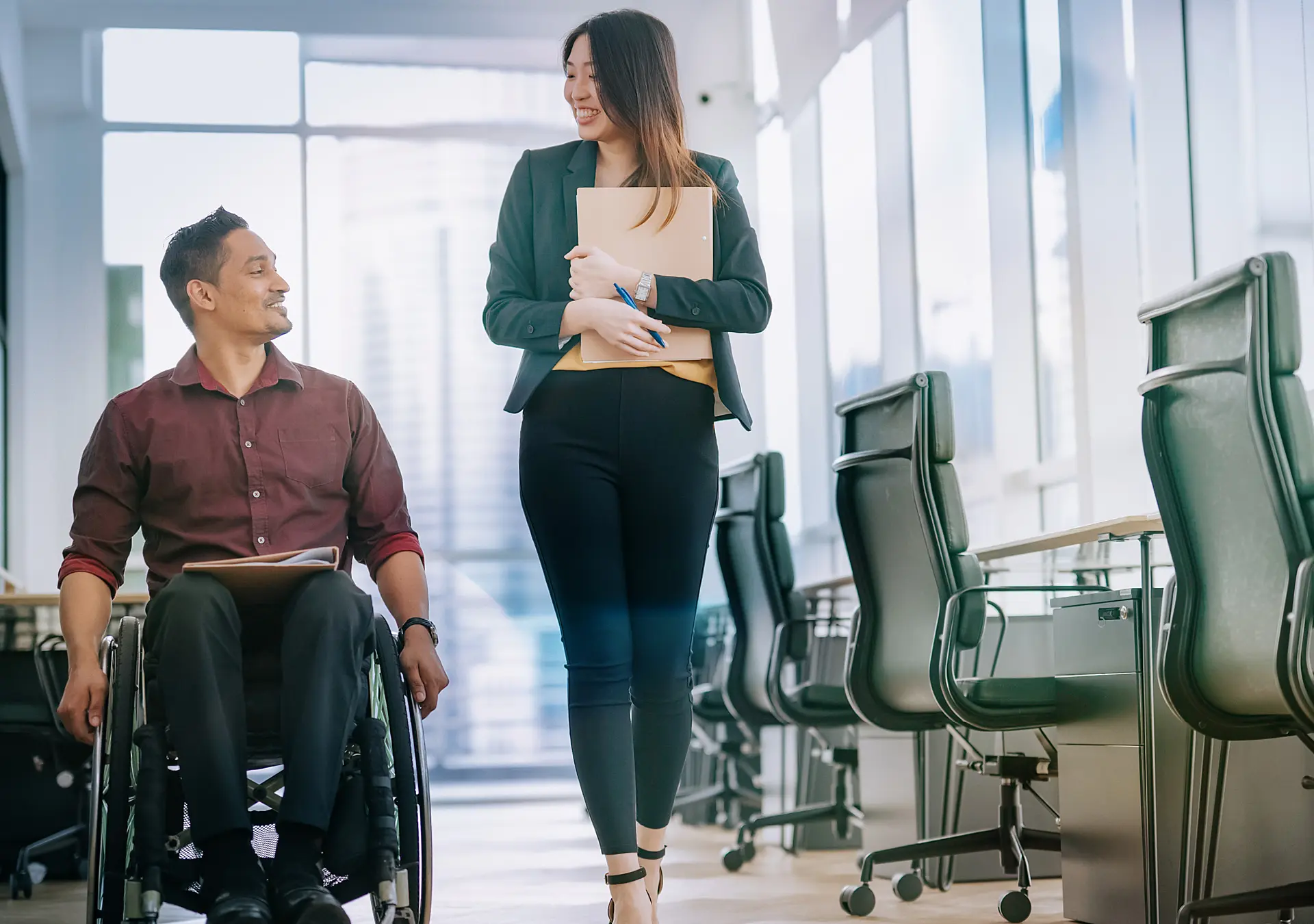
Accessibility is not something everyone thinks about until it affects their ability to maintain daily independence: when entering a space takes more effort than expected, when navigation is unclear or when everyday use becomes challenging. For many people, this shapes their everyday interactions with the world around them.
This exposes a disconnect.
Accessibility is still widely treated as a specialist consideration – designed for a particular group, rather than shaping how all of us move through and interact with the built environment. But if accessibility shapes how so many people engage with space, it raises a more fundamental question: Who are we really designing our spaces for?
Reframing Accessibility
In Ireland, 1 in 5 people has a disability. This figure alone challenges the idea that accessibility applies only to a small group of people, though it still doesn’t capture the full picture. Accessibility is often associated with permanent conditions, yet it encompasses a wider range of needs and situations.
For example, it affects:
- People who are neurodivergent
- Parents using buggies or strollers
- Someone recovering from an injury
- Visitors navigating unfamiliar places
These are not exceptional circumstances. They are the everyday realities of many people.
Accessibility is frequently designed around our current needs, without considering how those needs may change over time.
Ireland’s population is ageing. The number of people aged 65 and over is expected to grow significantly in the coming decades. Spaces that work well today can become harder to use over time if our changing needs are not considered during the design process.
Our needs vary and change:
- From person to person
- From one situation to the next
- Across the course of a single day
- As we move through different stages of life
Considering that our needs vary this widely, the idea of designing spaces for a “typical” user becomes increasingly difficult to justify.
The Limits of Designing for a “Typical” User
The built environment rarely reflects variability in use. Instead, it tends to assume consistency of movement, perception and understanding. This assumption is where many barriers are created.
Accessible design starts from a different premise: that variability is the norm, not the exception.
Much of the built environment is still designed around the idea of a “typical” user; however, this does not accurately reflect how people use spaces. The idea of a “typical” user simplifies complexity, but it does not reflect reality.
It assumes consistency where there is variation, and predictability where there is change. Designing for a “typical” user inevitably excludes people – not because their needs are unusual, but because variation between people has not been considered.
In practice, this shifts the burden away from design and onto the user, requiring people to adapt to spaces that do not fully support them. Accessibility challenges this model at its core and reframes the question from:
How do we design for a “typical” user?
to:
How do we design environments that work across a range of needs?
Designing with Accessibility in Mind
There needs to be a shift in how accessibility is approached in design.
Accessibility needs to be embedded from the outset of the project, shaping how a space is planned and ultimately experienced. Considering it at an early stage ensures that it becomes part of the design itself and helps inform decision-making, resulting in spaces that are more intuitive to navigate and use.
Despite this, accessibility is still frequently approached through the lens of compliance.
Regulations and standards are essential in setting minimum requirements. However, compliance alone does not guarantee that a space will work well in practice. When treated as a checklist, accessibility risks are often addressed in isolation – often much later in the design process – resulting in solutions that are not fully integrated into the overall design.
This approach focuses on meeting a set of requirements, rather than understanding how people actually use the environment.
By contrast, when accessibility is embedded as a design principle, it delivers wider benefits:
- Improved usability for a broader range of people
- Reduced need for costly retrofits or adaptations later
- Spaces that remain usable as people’s needs change over time
- Environments that are more welcoming and easier to navigate
In this context, accessibility is not an additional layer, it becomes integral to how a space functions and how well it performs over time.
A Shift in Perspective
Accessibility is often discussed in terms of requirements, standards and technical solutions – but it’s more fundamental than that. It is about how people use space, and whether the environments we create support them in doing so independently.
Throughout the design process, accessibility is often viewed as relevant to a specific group or in particular circumstances – in reality, its impact is far wider. Needs vary between people, across situations and over time.
Responding to this requires more than adjustments to the process. It requires a shift in perspective and moving beyond the idea that accessibility is an additional requirement and recognising it as integral to how design performs. It means moving beyond simplified assumptions of a “typical” user and designing instead for the range of ways people move through and interact with space.
Ultimately, the question is not whether accessibility should be included but whether design reflects the reality of how people live. Accessibility in the built environment requires more than meeting minimum compliance requirements. It involves careful coordination between regulatory obligations, user experience and practical design considerations to create genuinely inclusive spaces. Drawing on deep technical knowledge and project experience, our team works with clients throughout the project lifecycle to develop accessibility strategies that are practical, compliant and aligned with the needs of diverse users.
Learn more about our Accessibility Services

Zandalee is an experienced engineer and specialist in Accessibility and Universal Design. She leads the Accessibility Service line delivering solutions for major projects in complex building environments, including offices, student…
Related Insights