What Does a Good FRAEW Actually Look Like?
by Ashley Byard-Bellis
What Does a Good FRAEW Actually Look Like?
A Fire Risk Appraisal of External Walls (FRAEW) can play an important role in understanding the fire risk associated with an existing building’s external walls.
But completing a FRAEW is not, in itself, the objective.
For building owners and those responsible for managing a building, an important question remains: What gives us confidence in the conclusions reached?
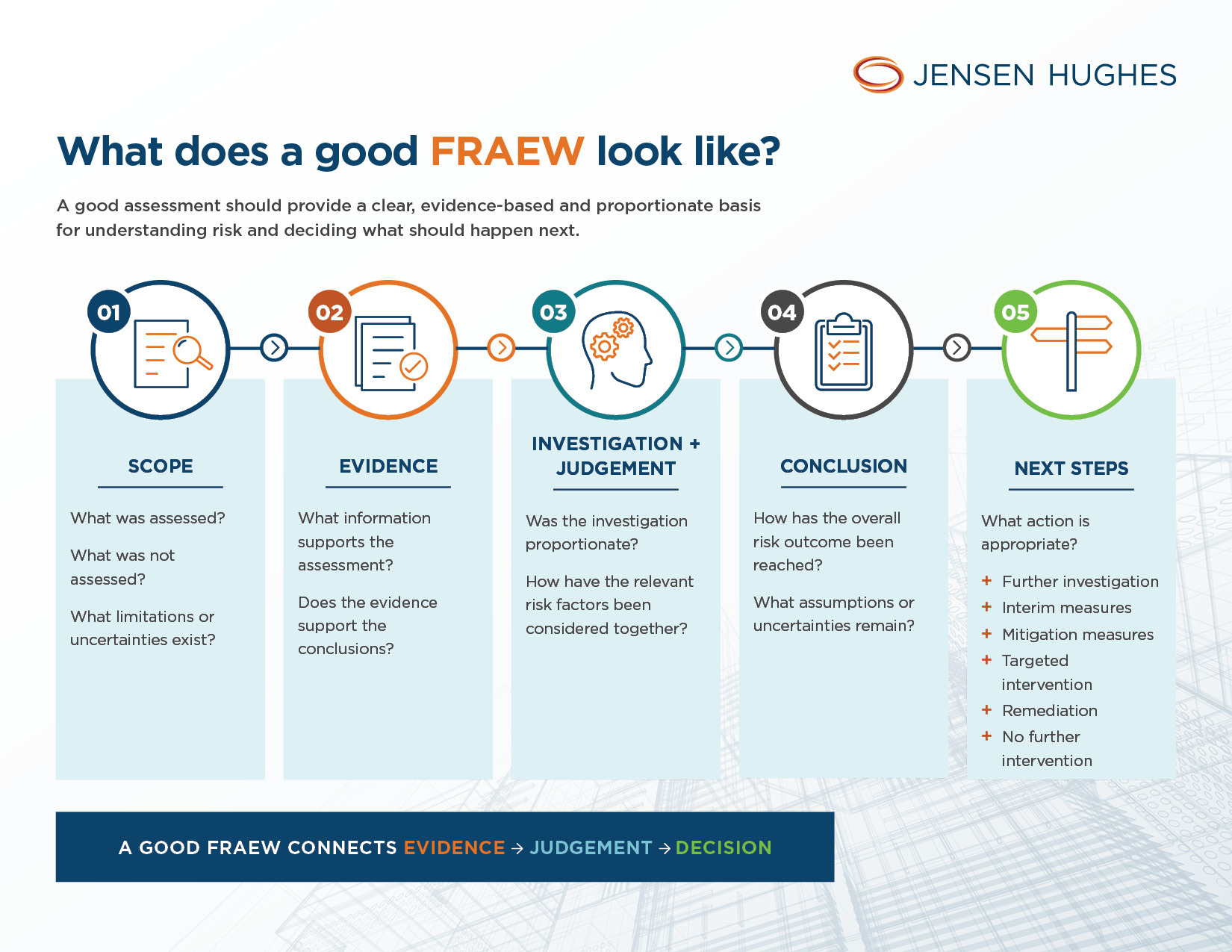
With PAS 9980:2026 now published, alongside new government guidance on recognising quality in a FRAEW report, there is a timely opportunity to look beyond the risk outcome and consider what a good FRAEW should actually provide. The question is not simply whether an assessment has been completed, but whether it provides a clear, evidence-based and proportionate basis for understanding the risk and deciding what should happen next.
Start with Clear Scope and Evidence
A good FRAEW should make clear what has been assessed, what has not been assessed and what information was available to the assessor. Existing buildings rarely come with a complete and reliable record of their external wall construction. Drawings may be incomplete, specifications may not reflect what was actually constructed and previous refurbishment works may have altered the original build-up.
These limitations do not necessarily prevent a robust assessment. What matters is that they are recognised and clearly communicated. The assessment should distinguish between what is known, what has been established through investigation, what has been assumed and where uncertainty remains. Evidence should then support the conclusions being reached.
This may include drawings and specifications, product information, previous surveys, intrusive investigations, photographs, fire test evidence, technical assessments and information relating to the building’s fire strategy and characteristics.
The important question is not simply whether evidence exists. It is whether the evidence is sufficient to support the conclusions reached.
Proportionate Investigation and Professional Judgement
Intrusive investigation can be an important part of establishing the actual construction of an existing external wall.
But more investigation does not automatically mean a better assessment.
The extent of investigation should be proportionate to the circumstances of the building, the information already available and the decisions that need to be made. Where uncertainty remains, the assessment should explain what that uncertainty means and whether further investigation is necessary to reduce it.
This is where professional judgement becomes important.
A FRAEW brings together a range of factors that influence external-wall fire risk, including the construction and configuration of the external wall, fire performance, building characteristics, fire strategy, occupant factors and firefighting provisions. These factors should not be considered in isolation. Their interaction is part of understanding the overall risk.
Tools such as risk matrices and tables can help explain an assessment, but they should support professional judgement rather than replace it. A good FRAEW should therefore make the reasoning behind the overall outcome understandable.
Be Transparent About Uncertainty
No assessment of an existing building is likely to be based on perfect information.
The important thing is to be transparent about what is known and what is not.
A good FRAEW should identify relevant assumptions, limitations and uncertainties and explain how they affect the assessment. This is not necessarily a weakness.
In many cases, clearly identifying an uncertainty provides a more robust basis for decision-making than presenting an assumption as established fact. It also helps identify where further investigation or analysis may be justified.
The objective is not to remove every uncertainty regardless of cost or consequence. It is to establish whether the available evidence is sufficient to support the judgement being made.
The Conclusion Should Support the Decision
Ultimately, a FRAEW should help building owners and those responsible for the building understand the external-wall fire risk and determine whether action is required. The conclusion therefore needs to do more than provide a risk outcome.
It should explain:
- What the assessment has found
- Which external wall systems or areas are affected
- Key factors influencing the outcome
- What assumptions or uncertainties remain
- Whether further investigation or analysis is required
- What action, if any, is considered appropriate
Where remediation or other risk-reduction measures are recommended, the relationship between the identified risk and the proposed response should be clear. Equally, where no further intervention is considered necessary, the basis for that conclusion should be understandable.
The objective is not simply to tell the reader what the conclusion is.
It is to allow them to understand how and why that conclusion has been reached.
What Does PAS 9980:2026 Mean for Existing FRAEWs?
PAS 9980:2026 is now the current published methodology for FRAEWs, replacing the 2022 edition. Alongside the revised PAS, the Government has published new guidance to help building owners, managing agents, residents and others recognise quality in a completed FRAEW.
The guidance highlights areas including clear scope, appropriate evidence, proportionate investigation, competence, transparent assumptions and limitations, professional judgement and clear conclusions and recommendations.
This provides a useful opportunity for building owners to ask better questions of the assessments they receive.
Importantly, the publication of a revised methodology does not automatically mean that every existing FRAEW needs to be repeated.
The Government guidance states that a competent FRAEW completed under PAS 9980:2022 should continue to be valid until it needs to be reviewed or updated. The question should therefore be whether the existing assessment remains appropriate in light of the building, the available evidence and its current circumstances.
From Assessment to Decision
A good FRAEW should leave a building owner with more than a risk rating.
It should provide a clear understanding of:
- What do we know?
- What don't we know?
- What does the evidence tell us?
- How has the risk been assessed?
- What does that mean for this building?
- What needs to happen next?
These questions form an important part of moving from Identification to Resolution.
The objective is not simply to produce an assessment.
It is to provide a sound basis for proportionate decision-making.
A Jensen Hughes Perspective
At Jensen Hughes, we believe that the quality of an external-wall assessment is reflected not simply in its conclusion, but in the evidence, reasoning and professional judgement that sit behind it. Our combined façade and fire engineering expertise allows us to consider the external wall in the context of the building as a whole, bringing together the technical understanding needed to support informed decision-making.
The objective is to help building owners understand the risk, understand the remaining uncertainty and determine what needs to happen next.
A good FRAEW doesn't just provide an answer.
It provides the evidence and reasoning needed to understand why that answer is appropriate.
Identification → Resolution → Assurance
This blog is a part of a series on cladding. Read the other blogs:
External Wall Risk Management for Building Owners
Understanding External-Wall Risk: What Good Identification Looks Like
From Risk to Resolution: Taking a Holistic Approach to External-Wall Performance

Ashley is the Director of Jensen Hughes’ Façade and External Wall Consultancy team, with over 19 years’ experience delivering façade engineering, façade fire safety, and external wall advisory services internationally. Ashley has led…
Related Insights