What Happens After a FRAEW?
by Ashley Byard-Bellis
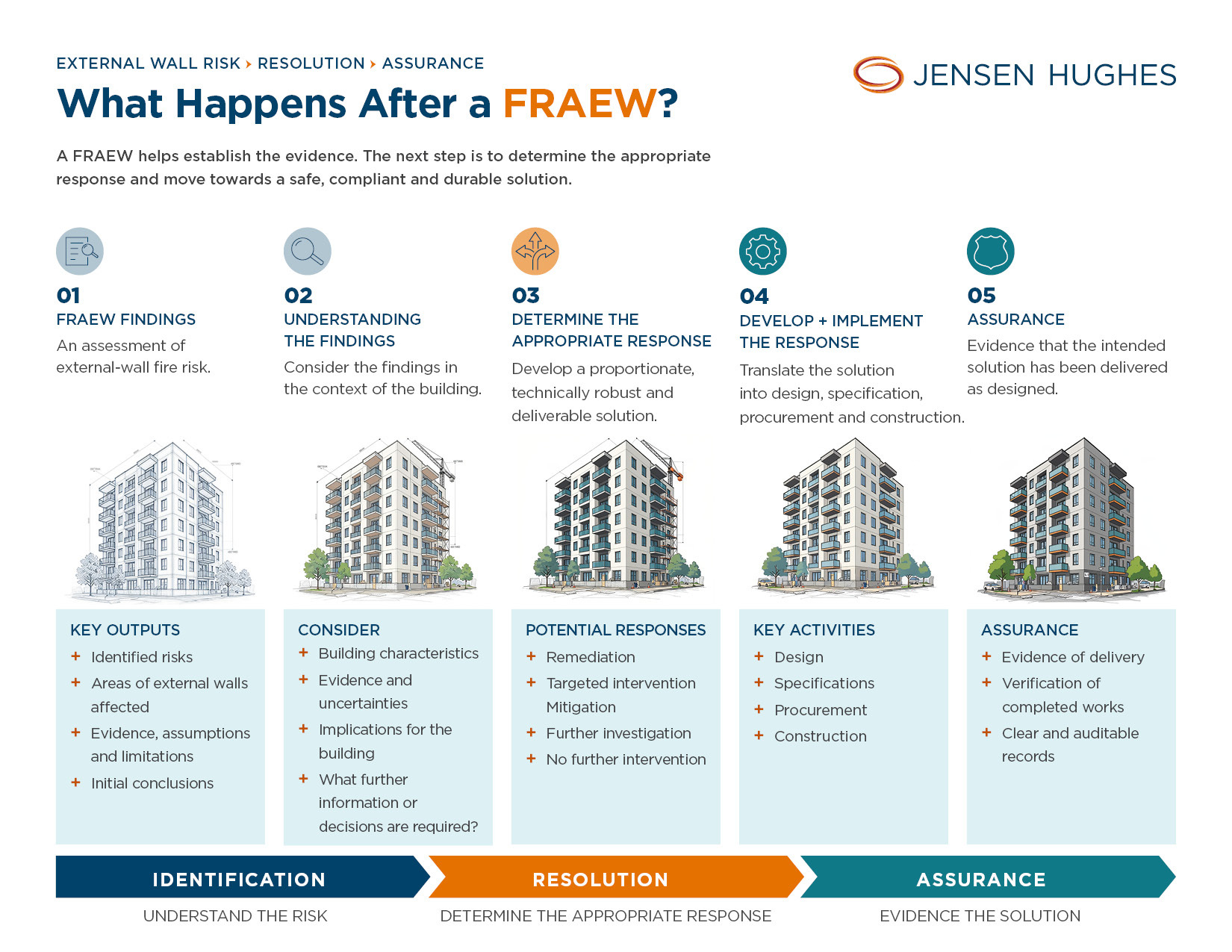
A Fire Risk Appraisal of External Walls (FRAEW) is not, in itself, a remediation strategy. Its findings need to be understood in the context of the building and used to inform decisions about the appropriate response.
The outcome may be that no further intervention is considered necessary. In other cases, it may identify a need for:
- Remediation
- Targeted intervention
- Mitigation
- Or further investigation before a decision can be made
The important point is that the assessment is part of the decision-making process, not the end of it.
From Assessment to Action
The first step after a FRAEW is to understand what its findings actually mean for the building.
This means considering the conclusions alongside the evidence on which they are based, any assumptions or uncertainties identified and the specific characteristics of the building.
The outcome should be a clear understanding of:
- Risks identified
- Areas of external wall affected
- Limitations or uncertainties in the available evidence
- Implications for the building
- What further decisions or actions may be required
This is important because the same broad finding can have very different implications depending on the construction, building characteristics and circumstances.
Determining the Appropriate Response
Where action is required, the next question is not simply, “How do we remediate it?” It is: “What is the appropriate response to the risk identified?”
Depending on the circumstances, this could include targeted remediation, replacement of affected components, mitigation measures or further investigation.
The preferred approach should be proportionate to the risk, appropriate to the building, technically robust and capable of being delivered.
This is where façade and fire engineering need to be considered together. The fire engineering perspective can help establish what the response needs to achieve from a fire-performance perspective, while façade engineering can help determine how that response can be incorporated into the existing construction and what wider performance considerations need to be addressed.
The objective is not simply to remove or replace a particular material.
It is to develop an appropriate solution for the building as a whole.
Looking Beyond the Fire Risk
As explored earlier in the series, an external wall is a system.
A proposed response to an identified fire risk can have implications for other aspects of façade performance. Changes to materials, insulation, interfaces or construction details may affect thermal performance, moisture, weather resistance, structural interfaces, durability or buildability.
A solution that addresses one issue in isolation but creates an unacceptable consequence elsewhere does not represent a complete resolution.
The response therefore needs to consider the wider performance of the external wall alongside the specific risk that led to the intervention.
From Strategy to Implementation
Once the appropriate response has been established, the focus moves towards implementation.
This may involve developing detailed design information, specifications, procurement information and construction requirements.
Existing buildings can introduce additional challenges. Access, sequencing, interfaces with retained construction, resident considerations, programme and contractor methodology can all influence how a solution is delivered.
These considerations should be understood early enough to inform the solution rather than becoming problems once work has commenced.
A technically appropriate solution needs to be capable of being procured, constructed and maintained in the context of the building.
Building a Defensible Position
The journey from FRAEW to implementation can involve a series of technical decisions.
Those decisions should be supported by a clear record of the evidence, options considered, assumptions, constraints and rationale for the approach selected.
Documenting the decision, not just the conclusion, helps building owners demonstrate how the response was developed and why it was considered appropriate.
It provides a stronger basis for progressing the project and maintaining a clear record as the work moves from assessment into design and delivery.
And Then Comes Assurance
Even once a solution has been developed and implemented, the journey is not necessarily complete.
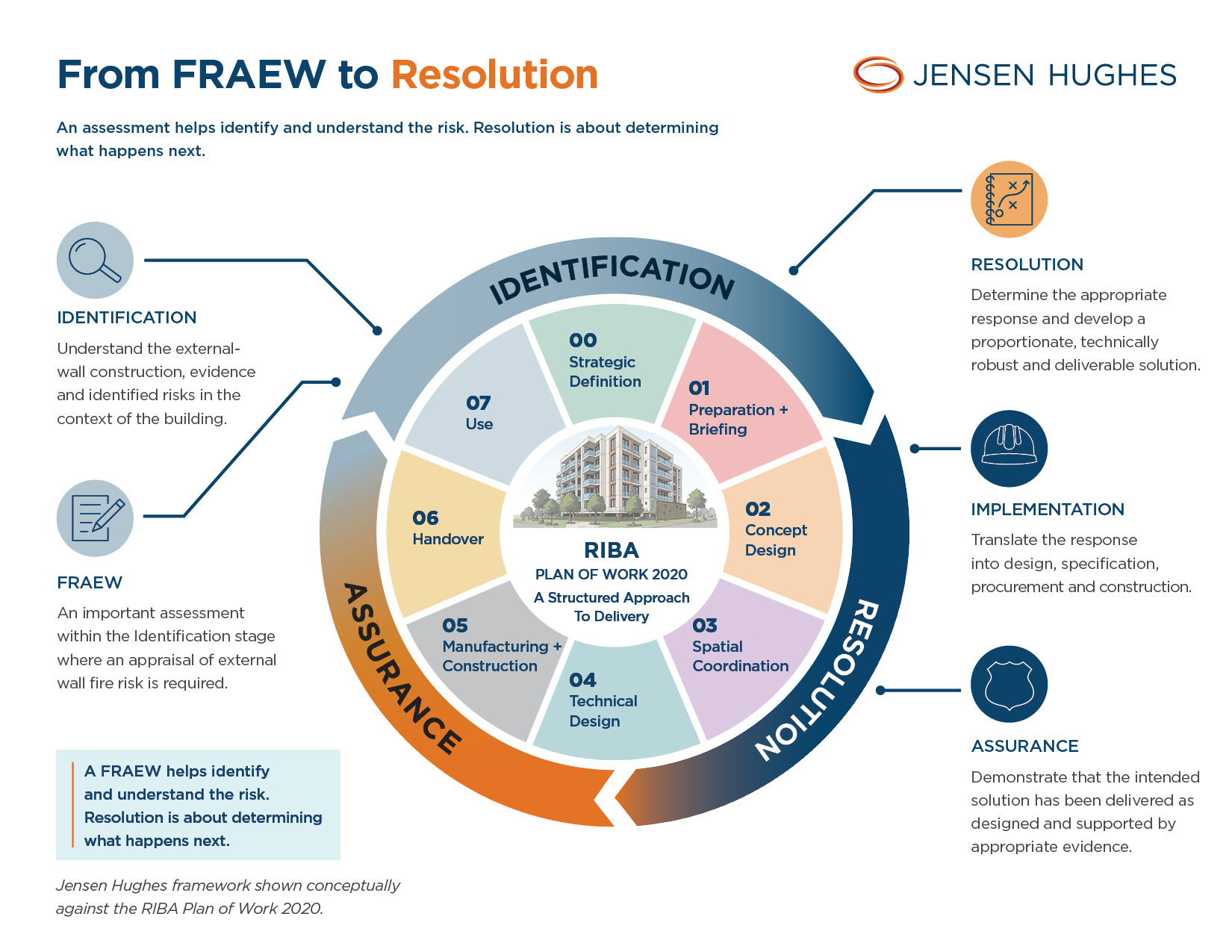
There needs to be confidence that the intended solution has been delivered as designed and that appropriate evidence exists to demonstrate this.
That is the role of Assurance.
It closes the gap between what was identified, what was designed and what was ultimately delivered.
A Holistic Approach at Jensen Hughes
At Jensen Hughes, we bring together façade and fire engineering expertise to support building owners across this journey.
We can help move from understanding the risk, to determining the appropriate response, to supporting its delivery and providing appropriate assurance.
The objective is a proportionate, technically robust and deliverable solution that considers the external wall as a whole.
Identification → Resolution → Assurance
A FRAEW may be an important point in the journey.
It is what happens next that turns understanding into action.
This blog is a part of a series on cladding. Read the other blogs:
External Wall Risk Management for Building Owners
Understanding External-Wall Risk: What Good Identification Looks Like
From Risk to Resolution: Taking a Holistic Approach to External-Wall Performance

Ashley is the Director of Jensen Hughes’ Façade and External Wall Consultancy team, with over 19 years’ experience delivering façade engineering, façade fire safety, and external wall advisory services internationally. Ashley has led…
Related Insights