The Battery Show 2026
Join engineers, executives, and innovators for in-depth sessions led by 250+ expert speakers covering battery development, EV technology, manufacturing, safety, sustainability, and more.
Access the Presentation: Batteries Behind AI
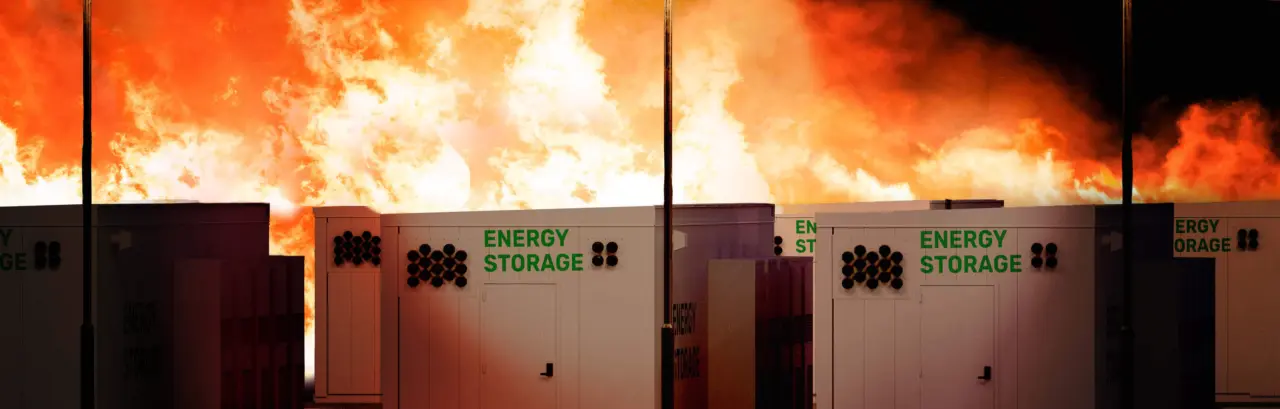
Following Chris’s presentation, access the gated presentation to explore how large-scale fire testing is helping organizations better understand thermal runaway, fire propagation, and the real-world behavior of battery systems.
As AI campuses grow larger and integrate battery storage, fuel cells, and complex energy infrastructure, project teams face unprecedented demand while navigating evolving hazards, codes, and standards.
10 Questions to Ask Before Deploying Battery Storage in an AI or Data Center Facility
Example Response:
We are deploying lithium iron phosphate (LFP) batteries. Compared with other lithium ion chemistries, LFP batteries generally have lower thermal runaway severity and are commonly selected for stationary energy storage applications.
How Jensen Hughes Can Help:
- Evaluate battery chemistry risks and hazards.
- Compare chemistries based on fire, explosion, and off gas behavior.
- Support technology selection during project planning.
- Develop battery hazard assessments and risk studies.
Example Response:
The energy is concentrated within dedicated outdoor BESS enclosures located adjacent to the substation. This minimizes stored energy inside occupied buildings and allows hazards to be managed in a controlled area.
How Jensen Hughes Can Help:
- Perform site and layout risk assessments.
- Evaluate distributed versus centralized storage approaches.
- Model potential fire and explosion scenarios.
- Recommend optimal battery placement and separation distances.
Example Response:
Each enclosure contains approximately 5 MWh of stored energy, resulting in a total project capacity of 100 MWh.
How Jensen Hughes Can Help:
- Evaluate energy density and associated consequences.
- Quantify fire spread and exposure risks.
- Determine appropriate spacing and protection strategies.
- Assess impacts to adjacent buildings and critical infrastructure.
Example Response:
The battery management system detects abnormal conditions and initiates alarms, isolation, and shutdown procedures. Testing indicates propagation is unlikely beyond the affected unit under the proposed configuration.
How Jensen Hughes Can Help:
- Conduct thermal runaway and propagation analyses.
- Evaluate detection and suppression systems.
- Validate mitigation strategies through engineering studies.
- Develop emergency response procedures for facility operators.
Example Response:
Yes. The system has undergone cell, module, rack, and full scale testing, including UL 9540A evaluations and large scale fire testing.
How Jensen Hughes Can Help:
- Review manufacturer testing reports.
- Identify gaps in testing programs.
- Design and execute large scale fire tests.
- Provide independent technical validation of results.
Example Response:
Yes. The tested configuration utilized the same chemistry, enclosure design, ventilation system, fire protection approach, and energy density proposed for the project.
How Jensen Hughes Can Help:
- Verify applicability of test results.
- Assess differences between tested and installed systems.
- Identify design changes that may invalidate previous assumptions.
- Provide engineering justification for AHJ review.
Example Response:
Testing provided insight into fire spread potential, heat release rates, off gas generation, flame extension, thermal propagation behavior, and suppression effectiveness.
How Jensen Hughes Can Help:
- Interpret complex testing results.
- Translate data into actionable design recommendations.
- Identify areas of residual risk.
- Communicate findings to owners, insurers, and regulators.
Example Response:
Testing results drove decisions related to enclosure spacing, ventilation, fire protection systems, emergency response planning, and protection of adjacent assets.
How Jensen Hughes Can Help:
- Incorporate test findings into project designs.
- Optimize fire and life safety strategies.
- Develop performance-based design solutions.
- Ensure safety objectives are supported by real world data.
Example Response:
Yes. The fire marshal, building department, utility representatives, and other stakeholders were engaged during conceptual design and provided with supporting testing data.
How Jensen Hughes Can Help:
- Lead AHJ engagement and technical discussions.
- Prepare code compliance packages.
- Support permit applications and approvals.
- Present testing data and engineering analyses to regulators.
Any change to battery chemistry, energy capacity, enclosure configuration, spacing, ventilation, or suppression systems triggers a review to confirm previous assumptions remain valid.
How Jensen Hughes Can Help:
- Evaluate design modifications and impacts.
- Update hazard analyses and risk assessments.
- Determine whether additional testing is required.
- Maintain code compliance throughout project execution.
Why All This Matters
The question is not simply whether a battery system has been tested.
The real question is:
Does the testing accurately reflect the battery system being installed, operated, and maintained in your facility?
How Jensen Hughes Supports the Entire Project Lifecycle
- Technology and chemistry evaluation
- Hazard and risk assessments
- Large scale fire testing
- Thermal runaway analysis
- Fire protection design
- Code compliance and permitting
- AHJ engagement
- Emergency response planning
- Commissioning support
- Operational readiness and training
- Design change reviews
- Independent technical advisory services
Test Early. Engage Early. Design With the Data. Jensen Hughes helps owners, developers, operators, utilities, and project teams make informed decisions from planning through operation.
Connect with Our Speaker
Christopher Unangst
Director - Industrial + Process Safety
Christopher Unangst
Director - Industrial + Process Safety
BS, Chemical Engineering, Certified Safety Professional, Fire Protection Engineer, Member, Member, Member, Certified Project Management Professional (PMP)