Immersion Cooling for Lithium-Ion Battery Energy Storage Systems: Balancing Safety + Efficiency
by Jensen Hughes and EticaAG
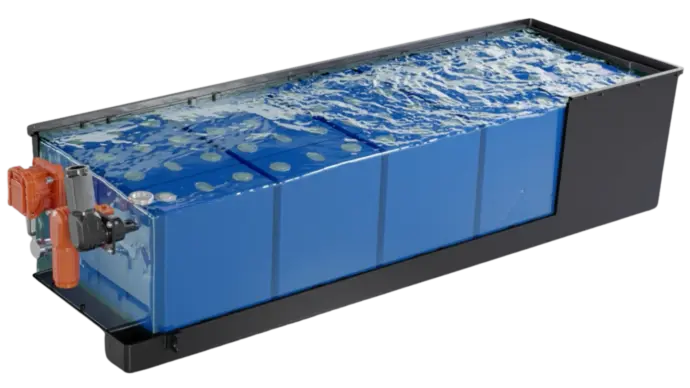
As demand for grid-scale energy storage grows, lithium-ion battery energy storage systems (BESS) have become a cornerstone of renewable integration and grid stability. However, managing heat within these systems remains a critical challenge. Traditional air and liquid cooling methods have served well, but immersion cooling – a technique where battery cells are submerged in a dielectric fluid – promises to redefine thermal management. This blog explores how immersion cooling works, why it is efficient, its safety implications and the pros and cons of adopting this technology.
How Immersion Cooling Works + Why It’s Efficient
Unlike air cooling, which relies on HVAC systems to circulate conditioned air, or indirect liquid cooling, which uses water-glycol loops around cells, immersion cooling places battery cells in direct contact with a non-conductive fluid. Fluid such as this includes synthetic esters, hydrofluoroethers or silicone oils, and has high thermal capacity and excellent dielectric properties, allowing heat to be absorbed and dissipated uniformly across all cell surfaces, including tabs and connectors.
Direct contact eliminates localized hotspots and minimizes interelectrode thermal gradients (ITGs). When left unmitigated, both hotspots and ITGs are known to accelerate degradation and shorten battery life. Immersion cooling also offers superior heat transfer compared to air or indirect liquid cooling, enabling systems to handle high-power charge/discharge cycles and operate safely in extreme climates. In some designs, static immersion requires no pumps, reducing auxiliary power loads, while forced-flow immersion can further enhance cooling performance.
Safety Improvements + Potential Hazards
Safety is a major driver behind advanced cooling technologies. Immersion cooling can reduce the risk of thermal runaway propagation. Studies have shown that dielectric fluids can limit thermal runaway to a single cell, preventing chain reactions that lead to catastrophic fires. Additionally, some fluids exhibit fire-resistant properties, adding another layer of protection.
It is important to note, however, that immersion cooling may introduce new hazards as well. Specialized fluids are often heavier and more expensive than water-glycol mixtures, increasing system weight and cost. While dielectric fluids prevent short circuits, leaks remain a concern especially if the fluid is flammable or if containment fails. Maintenance complexity also rises as systems must be monitored for fluid integrity and potential contamination. Furthermore, the industry lacks long-term data on immersion cooling performance and failure modes in stationary BESS applications, as well as UL9540A testing, making reliability an open question.
Pros + Cons of Immersion Cooling
Pros:
- Exceptional cooling uniformity and efficiency
- Reduced thermal gradients, improving battery life
- Potential to limit thermal runaway propagation
- Enabling of high-power, fast-cycle applications
- Less auxiliary power required to cool cells vs. liquid plate cooling due to increased cooling efficiency
Cons:
- Higher upfront cost and system complexity compared to air-cooled systems (similar to liquid- cooled systems)
- Slightly increased system weight, potentially reducing energy density per container if shipping weight limits are reached (e.g., container weight limits)
- Limited field data and unknown long-term reliability
- Possible hazards from leaks or fluid degradation, depending on the fluid used. Some newer synthetic esters are non-toxic, readily biodegradable and have high ignition points, helping lower flammability risk compared to conventional fluids
The Future of Immersion Cooling
Immersion cooling represents a promising evolution in battery thermal management. Its ability to deliver uniform cooling and mitigate safety risks could make it a preferred choice for next-generation energy storage systems. Yet, challenges around cost, complexity and untested failure modes must be addressed before widespread adoption. As research continues and commercial solutions mature, immersion cooling may well become the standard for high-performance, safe and reliable grid-scale storage.

Jens is VP of our Midwest Region, as well as a Subject Matter Expert in Industrial and Process Safety. He has hands-on experience in various disciplines such as engineering design, international and national engineering standards,…
Related Insights



Blogs + Whitepapers

Blogs + Whitepapers



Blogs + Whitepapers